
Home / Services
Generator Services for Windham County Homes
Losing power in Windham County can mean a lot more than a few dark hours. When the grid goes down here, it often takes the well pump with it, which means no running water. A boiler that needs electricity to fire loses the ability to heat the house. In winter, that is a short timeline before pipes freeze and real damage starts.
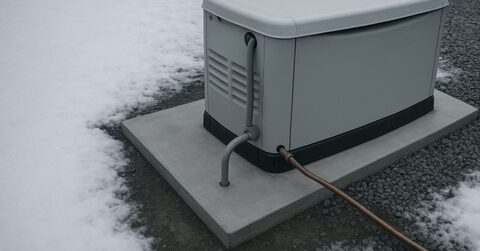
A standby generator changes that situation entirely. It monitors the utility line and starts itself the moment power drops, without anyone touching a switch. By the time you notice the lights flickered, the generator is already running and the transfer switch has isolated your home from the dead grid. Your pump comes back on and your boiler runs. The refrigerator keeps cold.
That outcome depends on the generator being the right size for the house. Undersized, and it struggles under load or shuts itself down. Oversized, and you paid for capacity you will never use and a unit that runs inefficiently when it does run. Sizing is done from a real load list, circuit by circuit, for your specific house. The square footage on the listing does not tell you whether the well pump is a half-horsepower or a one-horsepower, or whether the boiler has a multi-speed air handler. Those details matter, and they get collected before anything is recommended.
Not every situation calls for a whole-home standby unit. If your priorities are limited to a handful of circuits and you already own a quality portable generator, an interlock and an inlet may accomplish what you need at a fraction of the cost. That is an honest answer to give, and it is the one we give when it fits. The right solution is the one that matches what your house actually needs and what you are trying to protect.
Services
What We Do
Whole-home standby generator installation
A generator that starts on its own when the power goes out
Learn more →02Generator sizing and load assessment
Sized from a real load list for your house
Learn more →03Automatic transfer switch installation
The switch that moves the house onto generator power
Learn more →04Propane fuel supply and tank sizing
Tank size and fuel worked out for the run time you need
Learn more →05Portable generator interlock and inlet
A safe way to run your panel from a portable generator
Learn more →06Annual service and maintenance plans
A yearly service so it starts when you need it
Learn more →07Generator repair and diagnostics
Faults, no-starts and rough running diagnosed and fixed
Learn more →Installation work covers the full scope of what it takes to bring a standby system online. That includes the generator and automatic transfer switch, the fuel connection to a propane tank, and all of the wiring that ties those components together. Tank sizing is part of that conversation, because a generator that runs out of fuel during a multi-day outage solves nothing.
For homes where a portable interlock is the better fit, we install a code-compliant interlock kit at the main panel and an inlet box on the exterior of the house. That lets you connect a portable generator through a heavy-duty cord without backfeeding the utility line, which is the safety concern that makes improvised connections dangerous.
Once a system is in place, it needs regular attention to stay reliable. Standby generators run on an internal combustion engine, and like any engine they need oil changes, filter replacements, spark plug checks and load testing on a schedule. An annual maintenance visit catches problems while the generator is sitting quietly in your yard, not during an outage when you actually need it.
When a generator does develop a problem, whether it starts and stalls or will not start at all, diagnostics begin with reading what the control board is reporting and working methodically from there. Repair work covers both the engine side and the electrical side of the unit.
The clearest sign you need a standby generator is that a power outage at your address puts something at real risk: a well pump, a heating system, medical equipment, a freezer full of food that represents significant money, or simply the ability to stay in the house at all during a Vermont winter.
If any of those apply, the next question is how much of the house you need to keep running. Whole-home coverage means every circuit stays live. Essential-circuit coverage means the generator carries the loads that matter most and sheds the rest. Both are legitimate approaches, and the load assessment tells you what size gets you to each outcome and what each option costs.
If you have a portable generator and are wondering whether an interlock is enough, that is worth a straightforward conversation. Bring the generator's running-watt rating and a list of what you want to power. The math is not complicated, and the answer will be honest either way.
Windham County winters produce the kind of outages that last more than a few hours. Ice storms knock out lines that take crews days to reach on back roads, and the temperatures during those storms are exactly when you cannot afford to be without heat or water.
The work we do is specific to homes in this county. The well pumps and boilers on a property shape what a generator installation looks like and what size unit makes sense, as does the propane infrastructure already in place on many homes here. A load assessment for a house in Townshend or Grafton is going to look different from a generic sizing chart, because the house is real and the loads are actual numbers.
If you are early in the process and do not know yet what you need, that is a fine place to start. A sizing conversation does not commit you to anything. If you have an existing generator that has not been serviced in a while, or one that is showing a fault and not starting reliably, that is also a straightforward call to make.
The goal in every case is a system that runs when the grid does not, without you having to do anything to make it happen. Reach out and we can talk through what that looks like for your home.